
Strengthening the Open-Source Frontier: Lessons from the XZ Backdoor
(or how Social Engineering can compromise software security) The XZ incident exposes the fragility of solo-maintained projects against social engineering. To secure the internet’s backbone, future policies must prioritize financial support for maintainers, rigorous auditing of binary files, and reducing high-security software’s reliance on non-critical peripheral dependencies.
Yiannis Bakopoulos assisted by Gemini AI, Source : Veritasium
2/27/20262 min read
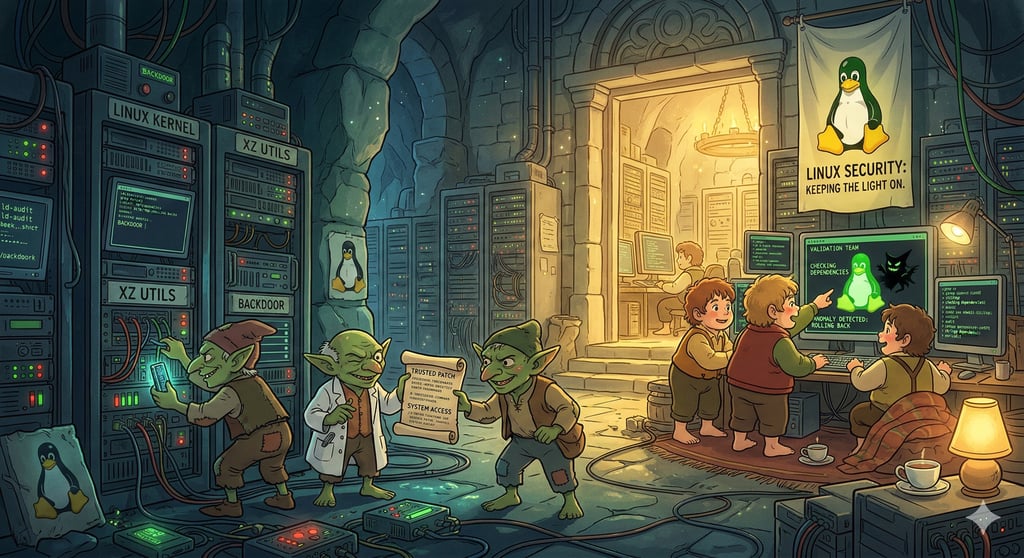

The XZ Utils backdooring attempt is a landmark event in cybersecurity, exposing how the "human element" is the most vulnerable point in the open-source ecosystem. This incident was not just a technical exploit but a multi-year social engineering campaign that nearly compromised the backbone of the internet.
The Core Actors and the Campaign
For nearly two decades, Lasse Collin maintained XZ, a highly efficient data compression tool, as an unpaid hobby project from Finland. By 2022, Collin was struggling with burnout and mental health issues, making him vulnerable to a sophisticated social engineering attack.
A persona named Jia Tan emerged as a "helper elf," consistently contributing high-quality code to the project. To accelerate Tan’s promotion to maintainer, several "sock puppet" accounts (likely manufactured identities) began pressuring Collin on public mailing lists, criticizing his slow response times and urging him to hand over control. Exhausted, Collin eventually granted Jia Tan maintainer status.
The Infiltration and Technical Exploit
Once in control, Jia Tan spent over two years meticulously weaving a backdoor into XZ. The hack was implemented in three stages:
1. The Trojan Horse: Malicious code was hidden inside "binary blobs"—test files that are typically ignored by human reviewers.
2. The Goldilocks Zone: Using a "dynamic audit hook," the exploit was designed to fire during a precise, microsecond window when a Linux system starts up.
3. The Cat Burglar: The goal was to compromise OpenSSH, the tool used for secure remote logins. The backdoor listened for a master key that only the attackers possessed, allowing them to bypass authentication and gain "root" (total) control of any server.
Uncovering and Mitigation
The scheme was narrowly defeated by Andres Freund, a Microsoft developer who was simply testing software performance. Freund noticed a microscopic slowdown of roughly 500 milliseconds during SSH logins. Investigating this "glitch," he discovered the backdoor and alerted the community in March 2024.
Immediate action was taken to neutralize the threat. Red Hat and other major Linux distributions (Fedora, Debian, and Ubuntu) issued urgent notices to users to roll back to older, safe versions of XZ. Jia Tan’s accounts were banned, and the XZ repository was scrubbed.
Future Linux Validation Policies
The XZ incident suggests that Linus’s Law—the idea that "with enough eyeballs, all bugs are shallow"—is insufficient when projects are maintained by a single, unsupported volunteer. Moving forward, Linux validation policies should consider:
• Support for Maintainers: Organizations that rely on open-source code must provide financial and technical support to solo maintainers to prevent burnout and vulnerability to social engineering.
• Dependency Auditing: High-security packages like OpenSSH must reduce their reliance on peripheral dependencies (like compression tools) to minimize the attack surface.
• Stricter Binary Reviews: Validation must move beyond human-readable source code to include rigorous testing of binary test files and build scripts.
Source: Veritasium

Explore
Discover the impact of technology on society.
Engage
Connect
email to...
This work is licensed under Creative Commons Attribution 4.0 International